








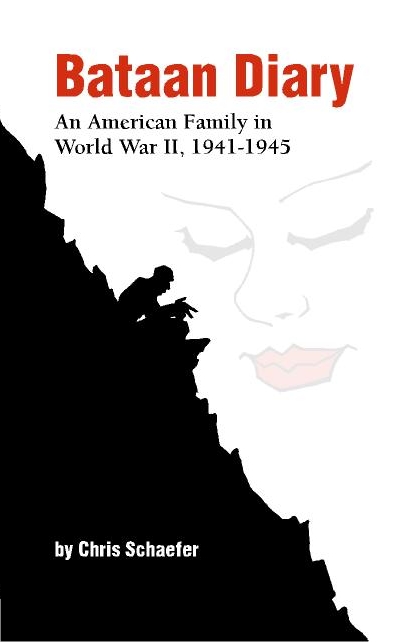
 Author Chris Schaefer
spent more than five years researching the material for Bataan Diary. The book
follows the life of an
American fugitive in the Philippines during the Japanese
occupation, and follows the life, hopes and doubts of his family
at home in the wartime United States.
Author Chris Schaefer
spent more than five years researching the material for Bataan Diary. The book
follows the life of an
American fugitive in the Philippines during the Japanese
occupation, and follows the life, hopes and doubts of his family
at home in the wartime United States.
Early in World War II the United States Army surrendered to the Japanese on Bataan, and 70,000 American and Filipino soldiers became prisoners of war. However, approximately 200 Americans refused the surrender order, and fled into the jungle to continue the fight and await the return of General MacArthur. It is estimated that another 200 escaped from the Death March. The Japanese hunted these men down. Almost half of them died in the first few months after their escape--victims of disease, treachery, and the Japanese.
Bataan Diary is the true story of one of these men, Lt. Col. Frank R. Loyd.
 The book was originally intended as a survival
story, but rapidly grew in scope as more and more information about
Frank Loyd and his associates surfaced. Frank Loyd survived
terrible diseases, near starvation, and a Japanese
man hunt sent to capture him. While following Frank Loyd's story
as a central theme, the book also describes the lives
and activities of other American evaders and escapees, the Filipinos
who risked their own lives to help the American soldiers survive, the
activities of the Manila underground, and the Catholic priests who
helped facilitate clandestine activities in the Japanese occupied
Philippines during the war. As General MacArthur's army
drew close in 1944, Frank Loyd joined the guerrilla
band of Corporal John Boone. The Philippine guerrilla
organizations and the Philippine underground helped discover and thwart
Japanese plans to destroy the approaching American army.
The book was originally intended as a survival
story, but rapidly grew in scope as more and more information about
Frank Loyd and his associates surfaced. Frank Loyd survived
terrible diseases, near starvation, and a Japanese
man hunt sent to capture him. While following Frank Loyd's story
as a central theme, the book also describes the lives
and activities of other American evaders and escapees, the Filipinos
who risked their own lives to help the American soldiers survive, the
activities of the Manila underground, and the Catholic priests who
helped facilitate clandestine activities in the Japanese occupied
Philippines during the war. As General MacArthur's army
drew close in 1944, Frank Loyd joined the guerrilla
band of Corporal John Boone. The Philippine guerrilla
organizations and the Philippine underground helped discover and thwart
Japanese plans to destroy the approaching American army.
During his ordeal Colonel Loyd kept a detailed diary and hid parts of it in various places in the jungle. He gave other portions to Filipino benefactors to hold until the war's end, and most of it was recovered after the war. His wife, Evelyn, was an active participant in the war effort at home and she kept her own diary and correspondence. Bataan Diary is based on these and other original documents, interviews with the participants and their descendents, and more than five years of the author's research into these remarkable events.
--Colonel Edwin Ramsey, Philippine Guerrilla commander and author of Lieutenant Ramsey's War
"Beautifully written. References are excellent."
--Beverly Hundley, daughter of American guerrilla Arthur "Maxie" Noble
"You have filled in a lot of gaps in my own knowledge of guerrilla operations in the Philippines--perhaps because you have managed to find sources of information unknown to me in the past twenty years."
--Historian Bernard Norling, author of four books on World War II in the Philippines
"This book should be read because even in defeat there is meaning and our nation needs people who will be inspired by the examples and stories of the guerrillas in the Philippines..."
--Edgar Wright III, son of American guerrilla Edgar Wright Jr.
- November 2004 book selection at the National D-Day Museum, New Orleans.
- June 6, 2005, Proclamation by Houston Mayor Bill White commending the Houston A&M Club and author Chris Schaefer for remembering and honoring the veterans of World War II.
Reviews:
The Decatur Daily,
Decatur, Alabama:
"The book is a story about the
triumph of the human will, about clandestine operations, intrigue and
betrayal. Correctly guessing whom to trust was as important to survival
as overcoming the ravages of malaria."
Read entire review by Richard McCann.
Richard McCann is Assistant Managing
Editor of the Decatur Daily. He is a former City Editor of the
Houston Post.
Journal of the American
Chamber of Commerce, Manila:
"Precisely because it’s not just one person’s view of
events in and around the
"Carefully
researched and footnoted, with a thorough bibliography and index, Bataan
Diary is nonetheless fast-moving and eminently readable. It even has really good maps."
Read entire review by Sara Collins Medina.
Sara Collins Medina is a free-lance writer, editor and
desktop publisher in
Philippine
Scouts Heritage Society:
"The book...also examines the larger war effort in the
Pacific and the involvement of other Americans and Filipinos, many of
them Philippine Scouts, in the anti-Japanese guerrilla movement on
Luzon. It contains interesting information on commando
infiltration teams, both Filipino and American, sent in by submarine to
help shore up the resistance movement. It also examines in some
detail prison camp conditions and the brutal counter intelligence
activities of the dread Japanese Kempei-tai
Read entire review by J. Michael Houlahan.
J. Michael Houlahan is a career Foreign Service officer whose
many assignments include the the U.S. Emabssy, Manila.
The
Park Record, Park City, Utah
"...the writing keeps the
readers' attention, working like a story to foster suspense and
interest. With its focus on characters and the places they
inhabit, the
book avoids the dryness or sterility which can often afflict a work
bent on objectivity. Because Schaefer's writing avoids these
things, the work is an easy read."
Read entire review by Matt James.
Matt James is Editor of the
"Scene," The Park Record newspaper, Park City, Utah.
| Sponsored links: |
| Park City ski condo rental |
|
Forgotten Soldiers movie |
Philippine  Scouts Heritage Society Scouts Heritage Society
|
 Top of Page
Copyright © 2004 - 2010,
Riverview Publishing. Updated 12/06/10.
Top of Page
Copyright © 2004 - 2010,
Riverview Publishing. Updated 12/06/10.